Selecting Living Room Size for Singapore HDBs
Singapore HDB living rooms often look generous on a floor plan but become tight once the sofa, dining table, coffee table, and side storage are in place. A 120 cm corridor, a 90 cm lift doorway, and a room measured in multiples of 30 cm can make a large-looking apartment surprisingly difficult to furnish. The right answer is not simply to buy less furniture; it is to measure the room, plan the circulation route, and choose pieces that fit both the space and the daily routines of the household.

At MIDHILL, we work with solid wood furniture for homes in Tampines, Bedok, Punggol, and across Singapore. The practical advice below covers sizing, delivery, costs, and the return policy, with numbers you can use before ordering.
What should you measure before buying a living room sofa?
Begin with the usable wall length, not the length of the room itself. Leave at least 90 cm for a clear walking route beside the sofa, 60 cm between the sofa and a coffee table, and 30–45 cm between the sofa and a TV console or wall. These are practical clearances, not decorative ideals. In a compact HDB living room, a 180–200 cm solid wood sofa may be more suitable than a 240–280 cm model, while a condo with a wider room may suit the larger size.
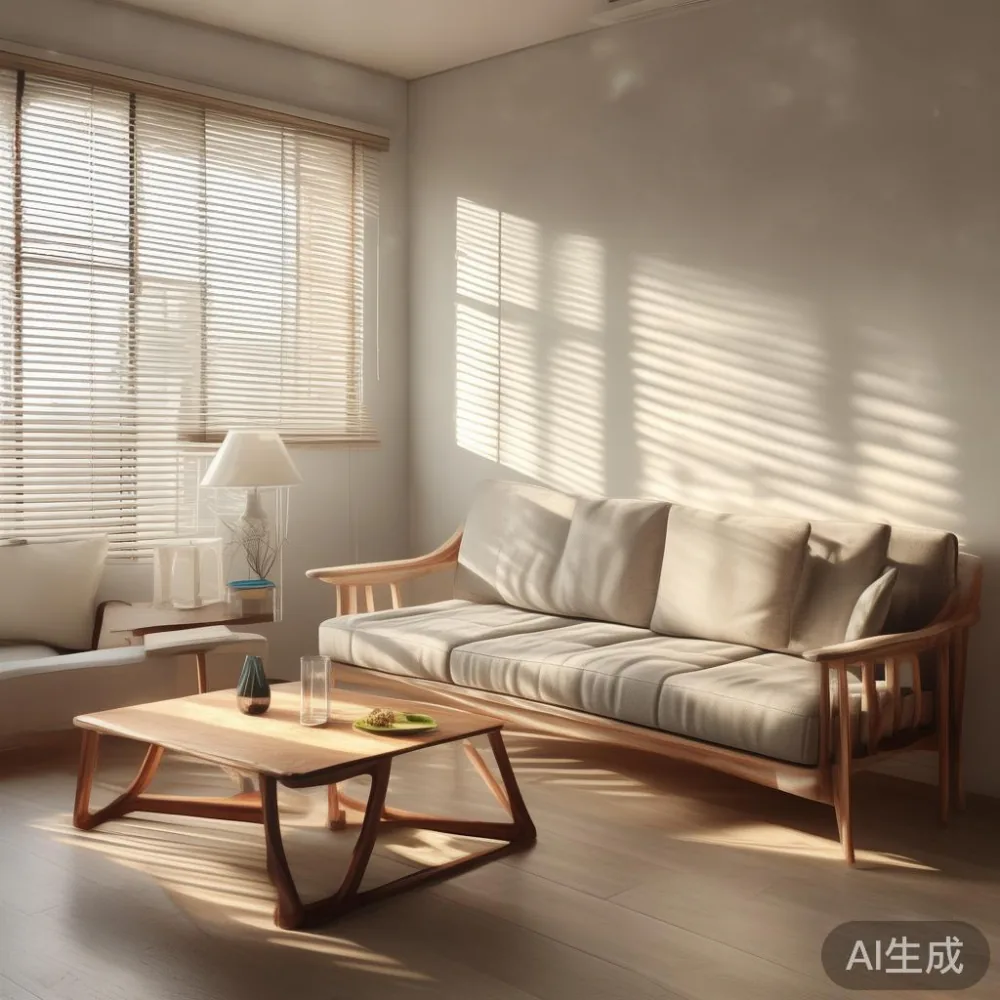
Measure the sofa’s actual width, depth, and height. A typical three-seat solid wood sofa may measure 200–220 cm wide, 85–95 cm deep, and 75–85 cm high. If the sofa must pass through the lift, check the lift door opening, internal diagonal, and turning space. A sofa that fits a 210 cm door may still be difficult to manoeuvre around a 90 cm corridor corner. Ask the seller for the packaged dimensions rather than relying only on the product dimensions.
Do not forget the coffee table. Leave 40–45 cm between the sofa seat and the tabletop edge. A 90 × 50 cm rectangular coffee table works in many HDB rooms, while a 100 × 60 cm table needs more breathing space. A round table with a 45–50 cm diameter can work better where the route narrows.
My colleague visited a Tampines HDB flat last month with a replacement sofa order. The room was 4.2 m long, and the previous sofa looked comfortable in photographs, but its 250 cm width left only 25 cm between one arm and the dining area. A 205 cm sofa created a more usable 70 cm passage. The visual difference was subtle; the daily difference was noticeable every time someone carried a plate from the kitchen.
How much space should you leave around a solid wood sofa?
<A sofa should be comfortable without turning the living room into a corridor. Keep the main route at 80–90 cm where possible, and allow 60 cm for secondary routes. The front edge of the sofa should sit roughly 35–45 cm from the coffee table, leaving room to walk behind it only if that route is needed. Against the wall, allow 5–10 cm for ventilation and cleaning rather than pushing the frame tightly into the corner.
Height matters too. A seat height of 40–45 cm is common for a solid wood sofa, while the back may reach 80–95 cm. If a low coffee table is used, check that the table does not sit directly against the seat, particularly where children or older adults use the room. A console placed behind the sofa should be no deeper than 25–30 cm, although a 20 cm gap behind the sofa is often enough for a slim charging shelf.
Check the proportions of the TV wall as well. A 140–165 cm television on a 180–220 cm console can feel balanced in a 3.8–4.5 m room. In a smaller 3.2–3.6 m room, a 120–140 cm television may be more appropriate. These ranges are not rules for every home, but they prevent a large sofa and oversized console from competing for the same wall.
Which dining table size fits a Singapore HDB living room?
For an open-plan living and dining area, measure the combined room length before choosing a dining table. A rectangular dining table for four people is commonly 140 × 80 cm, 150 × 85 cm, or 160 × 90 cm. A round table with a 100–120 cm diameter seats four people more easily in a narrow zone, but it still needs roughly 90 cm of clearance behind each occupied chair.
The dining table should not make the route from the lift lobby to the flat entrance feel like an obstacle. Keep 90 cm between the table edge and a wall, and 120 cm where a chair must be pulled back. For a round table, place it at least 90 cm from the sofa area if people need to walk around it. A 130 × 75 cm table can be practical for three diners or a smaller family, while a 180 × 90 cm model suits six people only when the room can maintain 90–100 cm around it.
Japandi for dining room styling works well in this context because simple solid wood dining tables, restrained chairs, and a light wall colour create order without filling every surface. A 150 × 85 cm oak-style dining table can pair with four slim-back chairs, allowing each person approximately 55–60 cm of table width. Marble table options can also work, but a 140 × 80 cm marble top should be checked for weight and delivery access. Stone tables may weigh 70–120 kg, so a two-person carry or professional handling may be needed.
What dimensions work for a bed frame and nightstand in an HDB bedroom?
Even if the focus is the living room, the bed frame and nightstand often influence the furniture budget and the layout of the whole flat. A queen bed frame is commonly 150 × 200 cm for the mattress itself, with an outer frame around 155–165 cm wide and 205–215 cm long. A king frame may measure 180–190 cm wide and 210–220 cm long. Add at least 60 cm along one side of the bed where possible, and 90 cm on the main side used for getting in and out.
A nightstand should fit beside the bed without narrowing the route. A width of 35–45 cm, depth of 35–40 cm, and height around 50–60 cm is practical for a queen bed. If the room is narrow, a slim 30 cm wide nightstand can provide a charging point and a small drawer. Avoid placing a nightstand where it projects into the door swing or reduces the path to the wardrobe.
The same clearance logic applies to a wardrobe. A 180–240 cm wide wardrobe can anchor one wall in an HDB bedroom, but the door panels need room to open. Check the full swing of each door: a hinged wardrobe may need 90–120 cm in front, while a sliding door reduces the projection. For a French light luxury or post-modern light luxury direction, decorative moulding can make the unit visually substantial, so it is sensible to choose a slightly narrower carcass if the room cannot provide a generous approach.
How do lift and corridor widths affect furniture delivery?
<Measure the lift door, lift car dimensions, corridor width, staircase turns, and the door opening of the HDB flat. A common HDB lift door opening is around 80–90 cm, although buildings vary. A 70 cm wide corridor may accept a slim nightstand but not a large wardrobe or sofa assembled in one piece. For a solid wood sofa, a modular frame or detachable back can make the difference between a straightforward delivery and a complicated one.
Before purchase, ask for the item’s longest and widest packaged dimensions, the number of cartons, and the estimated weight. A dining table may arrive in 2–4 protective packages, while a bed frame may require 2–3 cartons. A wardrobe can be divided into panels, but the tallest panel may still be 180–220 cm long. If the packaged dimension exceeds the lift’s usable diagonal, the seller should explain the delivery options before dispatch.
Use a tape measure rather than estimating. Photograph the lift controls, corridor corners, and flat door. Note the distance from the lift to the flat, because delivery workers may need 20–40 minutes to move the item. Delivery timing should be stated in days, not vague phrases such as “soon.” MIDHILL can quote a delivery window, and free shipping applies above US$350, with GST handled as part of the final checkout calculation where applicable.
How should you compare solid wood furniture sizes and prices?
Compare the usable dimensions, weight, construction, and total price. A solid wood sofa may cost SGD 1,800–3,200 depending on the frame size, upholstery, and finish. A 200 cm solid wood bed frame may cost SGD 900–1,600, while a dining table in the 150 × 85 cm range may fall around SGD 700–1,400. A 180 cm wardrobe may cost SGD 1,500–3,000, and a marble table may range from SGD 900–2,000 depending on the stone and base.
These ranges are useful for planning, not fixed price lists. Check whether GST is included in the displayed price. For example, an SGD 1,200 pre-GST item would add SGD 120 GST, making the total SGD 1,320. The material label should also be clear: solid wood, engineered wood, veneer, fabric, and stone have different care needs and price bands.
American light luxury furniture can be comfortable and broad, while French light luxury tends to use more visual detail. Post-modern light luxury often combines clean lines with a strong shape. The styling question should follow the measurement. A Japanese sofa vs Mid-century modern sofa comparison may be useful in terms of proportions, but the smaller Japanese-style sofa may still be the better fit for a 3.5 m HDB room. For storage, how to choose French wardrobe is less about chasing ornament and more about confirming panel dimensions, door movement, and the available approach space.
Consider the service terms too. MIDHILL has operated since 2008 and exports to more than 15 countries, offering a 10-year structural warranty and lifetime refinishing. A return policy gives a buyer time to inspect a delivered piece. For online furniture, ask how many days are allowed for reporting a manufacturing issue, whether the item must be unused, and who pays return freight. These details matter more than a decorative label.
Is French wardrobe worth it for a small Singapore bedroom?
The value depends on the room, not on the nationality of the style. A French wardrobe can suit an HDB bedroom if the carcass is proportioned to the wall, the doors have a usable opening clearance, and the finish complements the solid wood furniture elsewhere. A 150–180 cm wardrobe with two sliding doors may work better in a narrow room than a 200 cm hinged model, even if the latter has more storage volume.
Before deciding how to style French wardrobe in room, imagine the daily sequence: open the door, stand in front of the mirror, retrieve clothing, and move past the bed. Leave at least 60 cm in front of the wardrobe for a person to stand comfortably, and more if a chair or open drawer needs space. Check the height too. A 210–230 cm tall wardrobe draws attention upward, which can be attractive in a room with a 240–260 cm ceiling.
If the wardrobe has many mouldings, allow for visual weight and dust collection around ledges. If the room is compact, a flat-front or shaker-style option may be easier to maintain. The return policy should permit review of finish, colour, and scale before the wardrobe is installed permanently.
How can you avoid furniture sizing mistakes before delivery?
Make a simple floor plan with the room dimensions, doors, windows, sockets, and lift route marked. Place the sofa, dining table, coffee table, and nightstand as rectangles using their actual dimensions. Then draw a 90 cm circulation band from the flat door to the kitchen and balcony. Furniture should not block that route, and the coffee table should not sit so close to the sofa that people cannot walk behind it.
Use masking tape on the floor to test the footprint. Leave the tape for 2 days and walk through the room at normal speed. If you repeatedly turn sideways or move chairs to open the route, reduce the footprint by 10–20 cm. A solid wood sofa with removable arms or a dining table with a narrower top may solve the issue without compromising function.
Confirm the return policy in writing before paying. Look for a 14-day return period, the condition requirements, and the handling process for bulky furniture. Check whether the product is eligible for return, whether assembly is required, and whether the original packaging must be retained. For a marble table, also ask about damage reporting, since stone edges and corners need careful inspection immediately after delivery.
Finally, check the warranty and refinishing service separately from the return policy. A 10-year structural warranty addresses frame integrity; lifetime refinishing addresses the finish over the long term. Neither replaces a careful measurement. By combining a tape-measured plan with clear delivery information, Singapore families can choose furniture that feels light, proportionate, and comfortable rather than simply filling every available centimetre.